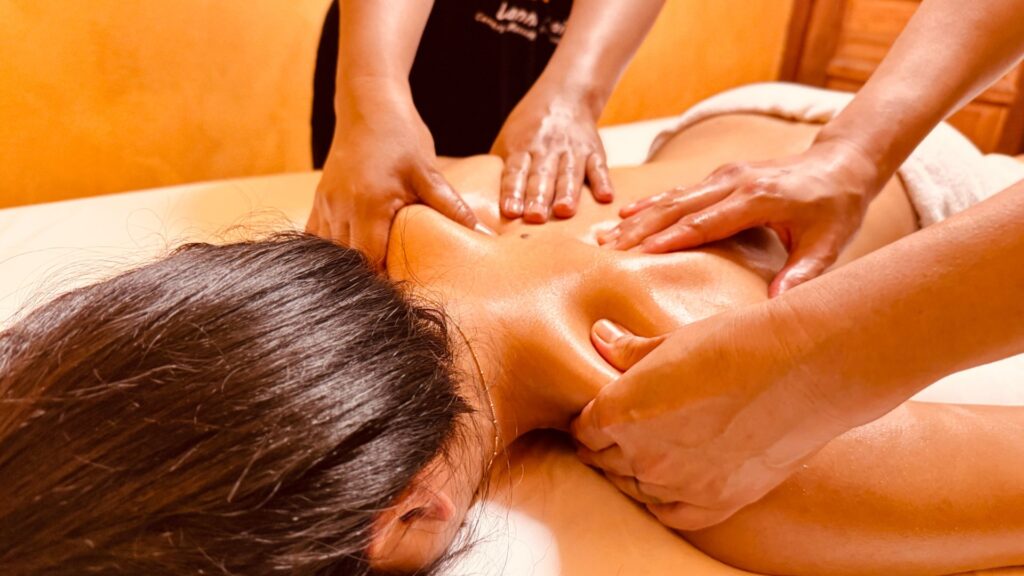
There are different types of Thai massage, each of which works on the body with a distinct rationale: there is that which uses structural pressure and deep stretching and that which prefers themore flowing action of warm oils to reach the innermost muscle strips and encourage release.
Understanding these substantial differences, helps guide you toward the experience best suited to your needs-a choice that truly changes theeffectiveness of your treatment!
Thai massage in two expressions: traditional and oil massage
When it comes to Thai massage, two major types are generally distinguished:
- Traditional Nuad Thai, “dry” treatment based on pressure, mobilization and stretching along the Sen energy lines.
- Oil massage, (such as Nual Reet Sen) using oils or herbal balms with continuous and deep techniques along the muscle lines.
Either way, both approaches aim to restore balance and release tension, but they do so with very different dynamics.
What is Nuad Thai, the traditional Thai massage
The Nuad Thai is the “classic” type of Thai massage, the one that represents the most authentic root of the tradition.
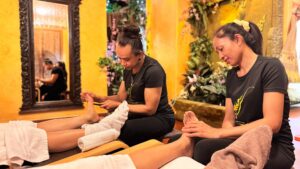
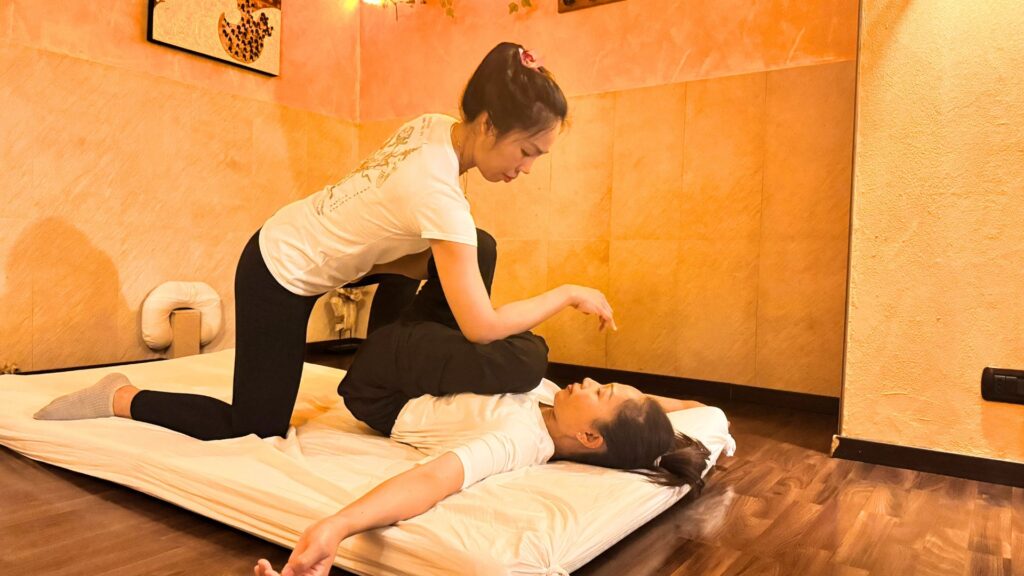
Specifically, this massage is practiced on a futon, with comfortable clothing, and involves the therapist working with pressure, levers, and stretches: the practitioner uses hands, thumbs, elbows, forearms, knees, and the weight of his or her own body to create deep, focused work.
In general, this type of massage is mainly performed “dry”: in some modern variants a trickle of oil may be applied, although this custom is not part of the traditional form.
Typical benefits:
- Relieves tension from posture and prolonged stress
- restores elasticity and a sense of lightness
- Improves joint mobility and energy circulation.
Oil massage according to the Nual Reet Sen tradition
The oil massage represents the other soul of Thai wellness.
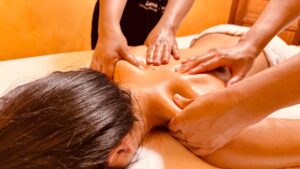
Here thepressure becomes smooth: the hands follow the path of the muscles steadily, promoting deep release. The most intense version, the Nual Reet Sen, employs natural oils or herbal balms, and is ideal for loosening stubborn stiffness and improving tendon flexibility.
Typical benefits:
- Excellent for localized pain in the back, neck, shoulders and legs
- Effectively works on the deeper muscle strips
- Offers modulated intensity with a “softer” perception than the vertical pressures of Nuad Thai
The differences between the Nuad Thai and deep-release types of massage
Although born from the same tradition, the two types of massage, traditional massage and relaxing Thai with natural oils, give completely different sensations.
- Nuad Thai focuses on stretching: pressure, stretching and manipulation to stimulate and balance the body.
- Oil massage emphasizes continuity of movement and the warmth of the oils, which accompany progressive work on the muscle strips.
They are two different paths leading to the same goal, but through different techniques, tools and feelings.
Comparing techniques: how they change the massage experience
In Nuad Thai, the body is accompanied in movements that expand the internal spaces, with sequences reminiscent of passiveyoga: stretching, pressing, joint rotations.
In oil massage, the maneuvers flow instead as a single gesture: strokes, kneading and continuous movements calm the nervous system and promote more regular breathing.
Basically, the former “reactivates,” the latter “dissolves.”
How tools change, from dry contact to hot oils
Nuad Thai uses only the therapist’s body-hands, elbows, knees, and levers-to modulate intensity and depth with extreme precision
In oil massage, coconut, jojoba, hot oil, or aromatic blends come into play instead, making the experience more sensory.
Gentler or deeper touches depending on the target
Nuad Thai offers more assertive and deeper work, ideal for “resetting” persistent tension and joint stiffness.
Deep-release oil massage is gentler in perception while working in depth, perfect when you need to relieve both mind and muscles together .
The role of aromatic balms in making massage even more effective
The use of special aromatic balms can intensify the results of different types of massage:
- Plai formula: with cassumunar ginger, fresh, often with hints of lemongrass, valued in Thai tradition for its soothing properties on stiffness and tension.
- Herbal Formula: softer, relaxing and aromatic, perfect for those who prefer delicate fragrances such as lavender or rose.
When to choose one type of massage over the other?
The choice of the type of massage depends on the needs of the moment and what the body needs at that stage.
Nuad Thai is particularly good when you feel stiffness related to posture or sedentary lifestyle, or when you want to regain elasticity and freedom of movement. It is also a good choice if you prefer a treatment that works in depth without the use of manual gliding techniques.
Oil massage, on the other hand, is ideal if you experience localized tension or particularly tight muscles, especially during periods of intense physical activity. With its enveloping contact and targeted work on the muscle strips, it accompanies the body toward deep release while maintaining a feeling of comfort and continuity.
Rely on Lanna Thai to choose the type of massage best suited to your moment
At Lanna Thai, you don’t choose a “catalog” type of massage: the starting point is always what your body is communicating . Posture, stiffness, stress level, breathing guide the choice of the most effective treatment. Sometimes it will be Nuad Thai, sometimes it will be Nual Reet Sen, sometimes it will be a targeted, tailor-made combination.
The body does not think in categories: it seeks balance. We accompany it toward that point of harmony.
Looking for wellness that puts you back in the center?
Choose the type of massage most attuned to your needs