Post-training aches and pains are not just “passing fatigue”-they often indicate that muscles are contracted and are a sign of poor tissue oxygenation, or even incomplete recovery. Stiff legs, a strained back, and tense shoulders slow recovery and increase the risk of overloading.
Thai massage intervenes right here: it works deep on the muscles, improves circulation and speeds up recovery time, helping the body become functional again faster.
What are post-workout pains and why do they appear?
Post-training aches and pains, those that occur after 12, 24, or 48 hours to be clear, are the body’s natural response to the intense stimuli of physical activity. They should not be perceived merely as “soreness,” but rather as small stresses on muscle fibers that trigger a process of reconstruction and adaptation.
When lactic acid, myofascial tension and joint stiffness accumulate, the body slows down. As such, movements become less fluid, energy drops, and the feeling of heaviness takes over. In these cases, recovery becomes an integral part of the workout itself, that invisible phase that results in better performance and injury prevention.
Why Thai massage promotes muscle recovery and relieves post-workout pain
Nuad Thai Boran, the ancient traditional Thai massage, integrates several techniques and is an extraordinary method for soothing post-workout pain because it works on three levels:
- Muscle: loosens contractures, stretches fascia, reduces soreness.
- Circulatory: reactivates blood and lymphatic flow, promoting oxygenation and detoxification.
- Energetic: rebalances the flow of chi, restoring clarity, concentration and mental calm.
In practice, then, Thai massage increases mobility, improves flexibility, accelerates defatigue, and creates a general condition of lightness that benefits both the professional sportsman and those who move only as a hobby.

Principles and useful techniques for reducing post-workout pain
Thai massage works not only on “reducing pain,” but on the causes of pain after training.
Through a series of techniques, it promotes more effective recovery, which not only relieves discomfort and tension, but really supports the complete regeneration of muscle tissue.
The key elements are:
Four pillars that, combined, allow the body to recover faster, reducing the risk of injury and restoring elasticity to strain-torn muscles.
Targeted pressures to melt fatigue in depth
Targeted pressures are the biomechanical heart of Thai massage.
Therapists modulate intensity and rhythm by using thumbs, forearms, or feet to work on the most contracted muscle strips: dissolving knots of tension, improving circulation, and relieving post-workout heaviness, especially on quadriceps, calves, buttocks, and lower back.
Passive stretching for effective lengthening
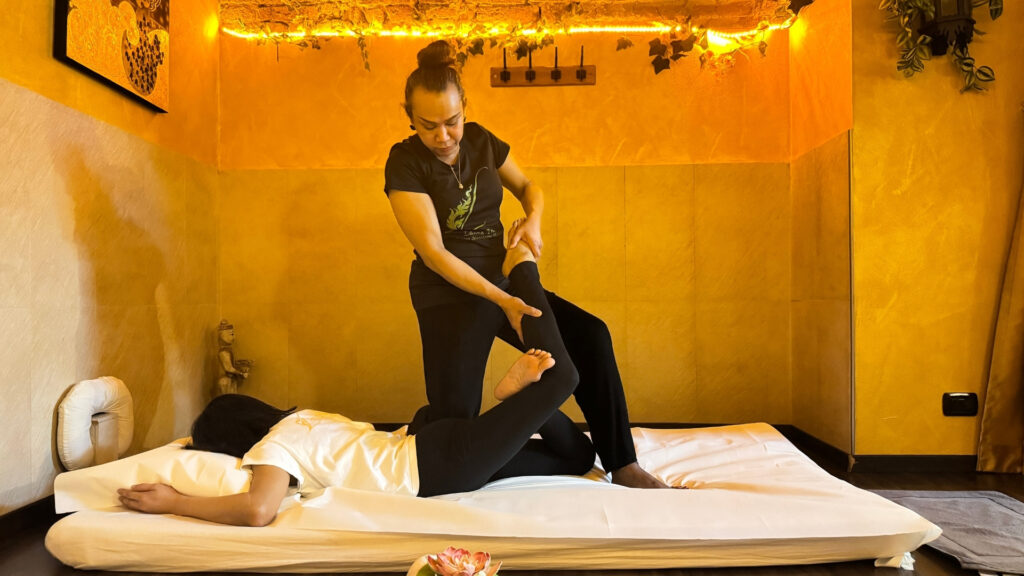
The thai passive stretching is a sequence of assisted stretches that gradually and safely take the body beyond its usual range.
It is a technique that loosens stiffness, stretches tendons and muscle fibers, improves mobility, posture, and facilitates the elimination of post-workout tension and pain, especially those accumulated after intense sessions involving the legs and back.
Joint mobilizations and dynamic stretches
A third technique, often underestimated, is joint mobilization, which allows, through controlled oscillations and gentle movements, to unlock joints and improve natural joint movement, preventing muscle decompensation and reducing micro-inflammation. Combined with dynamic stretches, this technique is invaluable for supporting fluidity of athletic movement, particularly for those who accumulate stiffness in the shoulders, neck, hips or ankles.
Sen line stimulation to rebalance energy and recovery
Sen lines are the energy channels of the Thai tradition, i.e., invisible pathways that run through the body and connect muscles, organs and the nervous system.
Stimulation of them, through slow, continuous pressure, reduces nerve fatigue and tension and restores lightness.. In short, it is the ideal support when, after a workout, muscle aches and fatigue are added to nerve strain.
How to integrate Thai massage into your daily sports routine?
Thai massage can become a strategic tool in any athlete’s routine, both to enhance performance and to promote faster and smarter post-workout recovery.
How often to perform the massage? It depends on the intensity of physical activity and personal goals: for those who train regularly, a treatment every 2-4 weeks can make a difference in the long run; at times of greater physical stress, even more closely.
And if you fear that Thai massage is painful, know that it is much more gentle and progressive than you think! We have discussed this in more detail here.
Regain balance and strength with thai massage at Lanna Thai center in Milan, Italy
At the Lanna Thai Center, Thai massage becomes a journey, beyond a simple treatment: a way to melt away fatigue and rekindle vitality and energy.
Do you too feel that post-workout pain is slowing down your progress? It’s time to turn to experienced hands.
Book your session
and turn recovery into a ritual of strength and well-being.