It is one of the oldest and most comprehensive practices in the world, a deep touch art of pressing, stretching and listening. However, there is one question that comes back often, especially among those approaching it for the first time: “But does Thai massage hurt?”
Accomplice to its reputation as an “intense” treatment, Thai massage is sometimes misunderstood. In reality, behind its strength lies extreme sensitivity. And when performed by skilled hands, no, it does not hurt, but liberates, relaxes and balances.
In this article we dispel some myths, explain what to expect, and help you understand when a Thai massage may be uncomfortable and when it is simply an expression of a body opening up.
Thai massage and pain: the false myths
Thai massage is not meant to hurt and is not an aggressive treatment. It is a meditative ritual that adapts to every body, every state, every energy.
Yet, prejudices are still widespread:
- “They walk all over you mercilessly”: yes, some techniques involve the use of the feet, but always in a controlled, gentle way and only if it suits the person.
- “It has to hurt to be effective”: no, a good therapist knows that pain is never the goal, but rather a signal to be listened to.
- “It is a brutal practice”: on the contrary, Nuad Thai stems from a spiritual tradition that puts respect for the body at the center.
A professional Thai massage never forces, but accompanies. And even when working on contracted or blocked areas, any discomfort is transient, managed, conscious.
When thai massage can be uncomfortable
Thai massage is a journey to wellness, but like any journey it has its more strenuous stages. Although the goal is always to loosen and release the body from tension and blockages, it can happen that some maneuvers are perceived as uncomfortable or “too strong.”
This does not mean that massage is wrong, but rather that every body reacts differently. But each path can be adapted, considering two main factors:
Understanding them means approaching Thai massage with awareness and peace of mind, knowing that each treatment can (and should) be modulated.
Pain threshold is subjective
Each body has its own history, and each person a different threshold of tolerance.
There are those who like firm pressure and those who prefer a gentler touch.
Then there are those who arrive contracted, stiff, tension-laden, and then, yes, some maneuvers may initially be less “comfortable.”
Stress or emotionality can also increase the perception of pain, but in good treatment, everything can be adjusted. Just talk about it with the therapist: massage is a dialogue, not an imposition.
Some techniques are more intense (but alternatives exist)
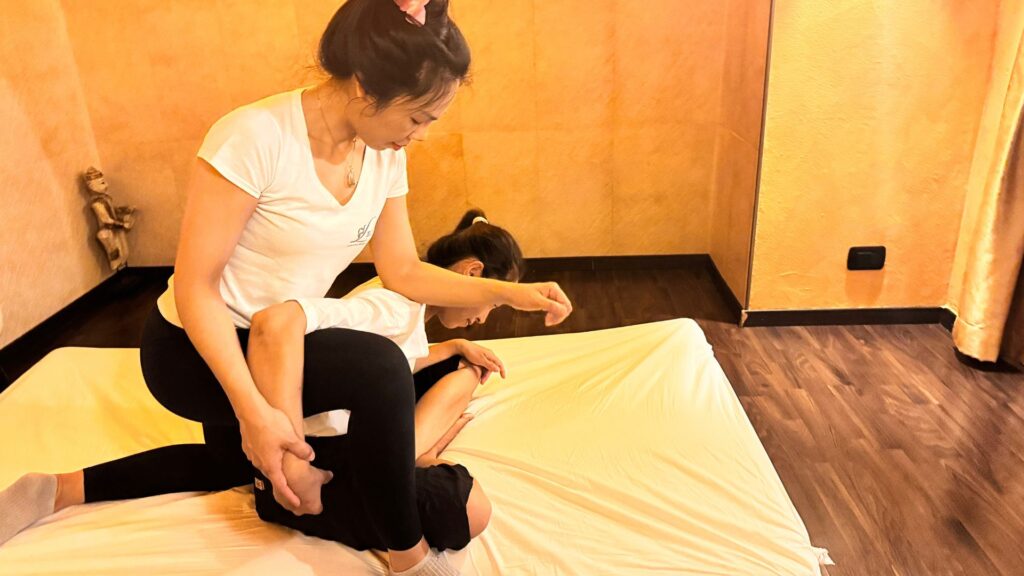
Traditional Thai massage uses stretches, deep pressure along the Sen, joint mobilizations. Powerful techniques that must be used judiciously and individually.
If you are looking for something softer, you can choose a Thai relaxation massage, a gentler version centered on breath and release, and involving the use of essential oils.
The key is always the same: personalization.
And then remember: like any technique or discipline, Thai massage has some contraindications.n way to regain centering, clarity and lightness in every fiber of the body.
How to recognize a properly performed Thai massage
A true Thai massage is not a “test to pass,” but a fine art. Touch, training and listening skills make the difference.
An experienced and professional therapist:
- start with an interview to understand your condition and calibrate treatment
- adapt each gesture to your body response
- Work fluidly, respecting your breath and your body’s natural rhythm
- never forces, but opens slowly, with presence and respect
The result? Not a “hard” massage, but an experience that regenerates, releases deep-seated tension, and leaves a lasting feeling of lightness.
So, does Thai massage hurt? At the Lanna Thai Center, it is deep, but not painful
At Lanna Thai Center we believe that Thai massage should never hurt, which is why every treatment is personalized. We welcome you into warm, quiet spaces designed for your well-being. The initial consultation allows us to understand who you are, how you are doing, and what you wish to receive.
You can choose from several types:
- Traditional Thai massage on futon
- Thai with warm compresses, for a more enveloping effect
- Thai oil massage, without stretching
- Customized pathways, integrated with holistic techniques
Each session is led by therapists with years of experience and a keen focus on the individual.
If you have experienced too much massage in the past, or fear that it may hurt you, we invite you to rewrite this experience with us.
Because when done right, Thai massage is never invasive.
A real Thai massage doesn’t have to hurt.
It has to do good. And we are here to prove it to you.